The bank robber’s mother’s alcohol dependence
Anxious PeopleThe Bank robber’s mother’s alcohol dependence is presented not as a background label but as an early family crisis that unsettles the child’s ideas about responsibility. Her drinking reaches into the household’s finances and security, yet the Bank robber remembers her without being able to reduce her to a villain. The episode that best defines their relationship joins money, shame, and a plea for forgiveness that never quite becomes an apology.
Childhood and the household
When the Bank robber was seven, her mother was already prone to getting drunk despite not intending to do so. The child understood the contradiction before understanding its causes: a promise not to drink did not prevent the drinking from happening again. The mother’s dependence therefore appears through its repetition and its effects on family life, rather than through a clinical description.
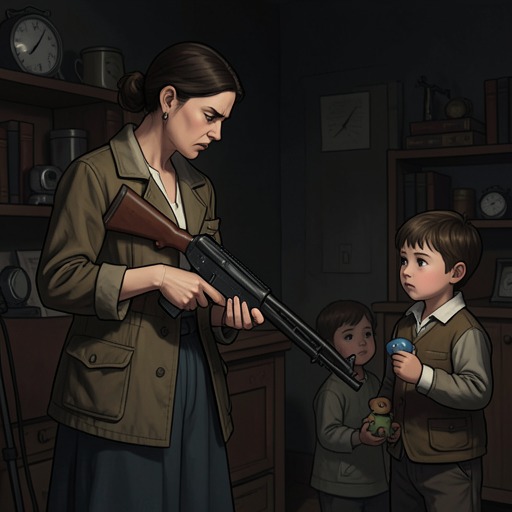
The child had spent the month before Christmas selling magazine Christmas editions after school. She gave the money to her mother so that the household could buy food for Christmas. The money was not spare; the child had worked for it with a specific need in mind. In the scene the mother kneels on the kitchen floor and clings to her child, distressed and intoxicated, with cigarette ash in the child’s hair. She says that the child should not be upset with her and that what happened was not really her fault. The child gradually understands that the money has been spent and that the mother is turning the child’s contribution into a reason the child should not blame her.
Money, blame, and the closest apology
The mother’s words about the money reverse the ordinary direction of responsibility: instead of asking forgiveness for using what her child had earned, she tells the child that the money should not have been given to her. The Bank robber later recognizes this as the closest her mother ever came to asking forgiveness. The moment is emotionally complicated because the mother acknowledges something has gone wrong while avoiding a direct admission of responsibility.
The episode also gives the Bank robber an early, intimate version of the idea of moral hazard. Years later, she considers the incident less for its obvious cruelty than for the strange persistence of her attachment: she cannot hate her mother, and even in retrospect the event does not feel entirely like her mother’s fault. That response does not erase the child’s loss or the mother’s dependence. Instead, it shows how affection and blame remain entangled in the Bank robber’s memory of the person who harmed her and whom she still loves.
The narrator connects this family history to the Bank robber’s later encounter with financial responsibility and risk. As a child, she had not had enough money to hear a bank employee explain moral hazard; her first understanding came through the money she earned for food and her mother’s appeal not to be blamed for its loss. The parallel is not that the two situations are identical, but that the question of who bears the consequences of a decision enters the Bank robber’s life first through family, need, and loyalty.
Eviction and the promise to be different
The family was evicted from its apartment the following February. The narrative places this material consequence close to the Christmas episode: the household’s insecurity is not an abstract fear but a loss of housing. The Bank robber responds by vowing never to become a parent. When she later does become a parent, she makes a narrower promise: she will not become chaotic in the way she associates with her mother, unable to manage adulthood, bills, or a home for her children.
That vow becomes an important measure of the Bank robber’s later self-understanding. She wants to distinguish her own parenting from the instability she experienced, yet the narrative shows that a promise alone cannot guarantee a secure life. Her later fear of failing her daughters echoes the childhood fear of a parent whose drinking and financial choices could place the family’s basic needs at risk. The mother’s history thus persists not simply as a memory of drinking, but as a standard against which the Bank robber judges her own capacity to protect her children.
The mother’s death and remembered advice
The account of the mother’s death preserves the same mixture of damage and attachment. She had consumed so much gin and tonic that those dealing with her body feared cremation might cause an explosion. The detail is darkly comic, but it does not turn the mother’s dependence into a harmless eccentricity: it registers how thoroughly alcohol had come to define the circumstances surrounding her death. The narrator immediately balances this image with the reminder that the mother could still offer useful advice.
One of her remembered sayings concerned the need to run back for forgotten ice and lemon: if a person’s head could not manage the task, the person’s legs had better do so. The advice is practical and memorable, and its persistence complicates any simple portrait of the mother as only a source of harm. The Bank robber carries both the effects of her mother’s failures and the mother’s words forward. The narrative’s humor does not cancel the grief or the childhood deprivation; it shows how family memory can retain wit and affection alongside injury.
Narrative significance
The mother’s alcohol dependence helps explain why the Bank robber is so alert to the difference between intention and outcome. Her childhood included a mother who did not plan to get drunk, a child who tried to contribute to the household, and consequences that arrived regardless of anyone’s stated intentions. Later, the Bank robber’s determination not to repeat that pattern sits beside her recognition that life can take a course no one planned. The connection is a pattern of remembered responsibility, not a claim that the mother’s dependence alone determines her daughter’s later choices.
Most importantly, the episode resists a clean verdict. The mother’s actions cost the child money meant for food, and the family lost its apartment; the child nevertheless cannot make hatred fit her feelings. That unresolved affection becomes part of the Bank robber’s wider struggle to decide when a person is at fault and whether a bad action can define an entire life. The mother’s dependence therefore matters both as a concrete source of childhood insecurity and as the first family relationship through which the Bank robber learns that love, harm, and accountability may remain inseparable.